WtERT Becomes an Official Observer of the International Zero-Waste City Network
The nonprofit scientific research association, joins UNEP-backed network to bring science-based waste-to-energy expertise to zero-waste city development worldwide
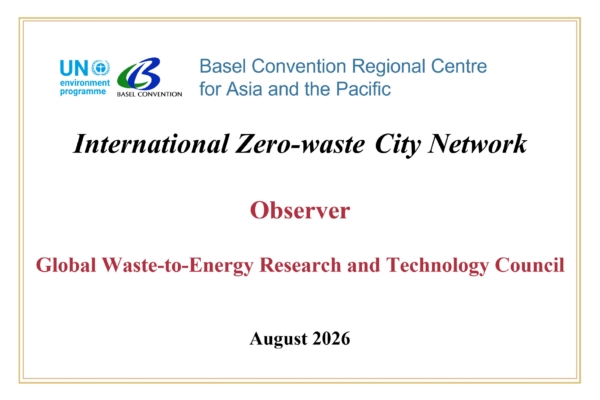
We are pleased to announce that WtERT®, the Global Waste-to-Energy Research and Technology Council, has formally joined the International Zero-waste City Network as an observer. Following two rounds of consultation, WtERT® has been welcomed into this international platform working to advance zero-waste approaches, circular resource use, knowledge exchange and sustainable urban development worldwide, and we are honoured to receive our official observer plaque from Mr. Qingyin Dong, Senior Programme Officer and Chief of the Regional Waste Management Branch at the Basel Convention Regional Centre for Asia and the Pacific.
The International Zero-waste City Network was initiated by the Basel Convention Regional Centre for Asia and the Pacific (BCRC China) in 2022, and is co-sponsored by BCRC Argentina, BCRC Egypt, BCRC Indonesia, BCRC Iran, BCRC Russia, BCRC South Africa, BCCC Uruguay, and the Ministry of Environment, Urbanization and Climate Change, Türkiye. As of July 2026, the Network counts 108 members, including nine co-sponsors, and nine observers. Its aim is to help cities and other entities meet a core set of targets that secure their long-term environmental, social and economic sustainability, in line with major international, regional and national instruments and policies, with particular emphasis on advancing the Sustainable Development Goals. Membership and observer status are open to governments at the provincial, city, or local level, as well as institutions such as associations, universities, research institutions, and group enterprises that wish to support the Network’s mission.
The Network is supported by the Basel Convention Regional Centre for Asia and the Pacific, based at the School of Environment of Tsinghua University in Beijing, and established in 1997 by decision of the Conference of the Parties to the Basel Convention on the Control of Transboundary Movements of Hazardous Wastes and Their Disposal, one of fourteen Basel Convention Regional and Coordinating Centres worldwide. Since 2011, the Centre has also served as the Stockholm Convention Regional Centre for Capacity-Building and the Transfer of Technology for Asia and the Pacific, with technical expertise spanning hazardous waste, e-waste, plastic waste, waste batteries, POPs wastes and mercury wastes, and “Zero-Waste City” construction. The Basel Convention itself is a global environmental agreement addressing the transboundary movement and environmentally sound management of hazardous and other wastes, work that grows more important as cities seek to prevent waste generation, recover valuable materials and reduce the environmental and health impacts of unsustainable production and consumption. BCRC’s Zero-Waste City programming has been developed in direct partnership with the United Nations Environment Programme (UNEP); flagship events such as the International Day of Zero-Waste have been co-hosted by UNEP, UN-Habitat, BCRC-AP and national environmental authorities, anchoring the IZWCN firmly within the global sustainable-development and circular-economy agenda that UNEP champions.
This vision connects directly with WtERT®’s mission. Founded at Columbia University’s Earth Engineering Center and now jointly led with Zhejiang University’s College of Energy Engineering, WtERT® is a nonprofit academic council dedicated to advancing the best available technologies for recovering materials and energy from residual, non-recyclable waste, bridging industry and academia across some 30 countries. As an Observer of the IZWCN, WtERT® will contribute scientific, evidence-based guidance on best practices for material and energy recovery from residual waste, drawn from its global network of university chapters, research working groups, and its SOFOS knowledge database; independent, technology-neutral research on waste valorization pathways, including material recovery, biological treatment, and thermochemical conversion, to help cities choose approaches suited to their local waste streams; applied research and technical advice supporting the environmentally sound and safe disposal of waste that cannot be recycled or otherwise recovered; and academic capacity-building that connects IZWCN member cities with WtERT®’s worldwide network of researchers, engineers, and policymakers. WtERT® maintains a science-based, data-driven approach and does not promote any single solution in isolation, holding a neutral, academic position independent of commercial or political interests, an evidence-first stance that aligns closely with the Network’s own mission.
We look forward to contributing evidence-based waste-to-energy expertise from our global academic network, learning from other Network participants, and exploring new collaborations that turn zero-waste ambitions into practical, science-driven solutions for cities everywhere. We sincerely thank the Basel Convention Regional Centre for Asia and the Pacific, the School of Environment at Tsinghua University, and the International Zero-waste City Network for this recognition and warm welcome a meaningful new step in WtERT®’s mission to advance a just and prosperous circular economy.
For more information on the International Zero-Waste City Network, visit https://www.bcrc.cn/IZWCN.