
Reducing Landfill Methane Emissions and Expansion of the Hierarchy of Waste Management
Authors: Nickolas .J. Themelis
Affiliation: Earth Engineering Center, Columbia University
Published in: Paper included in Proceedings of Global Waste Management Symposium, Rocky Mountains, CO, Sept. 7-1, 2008
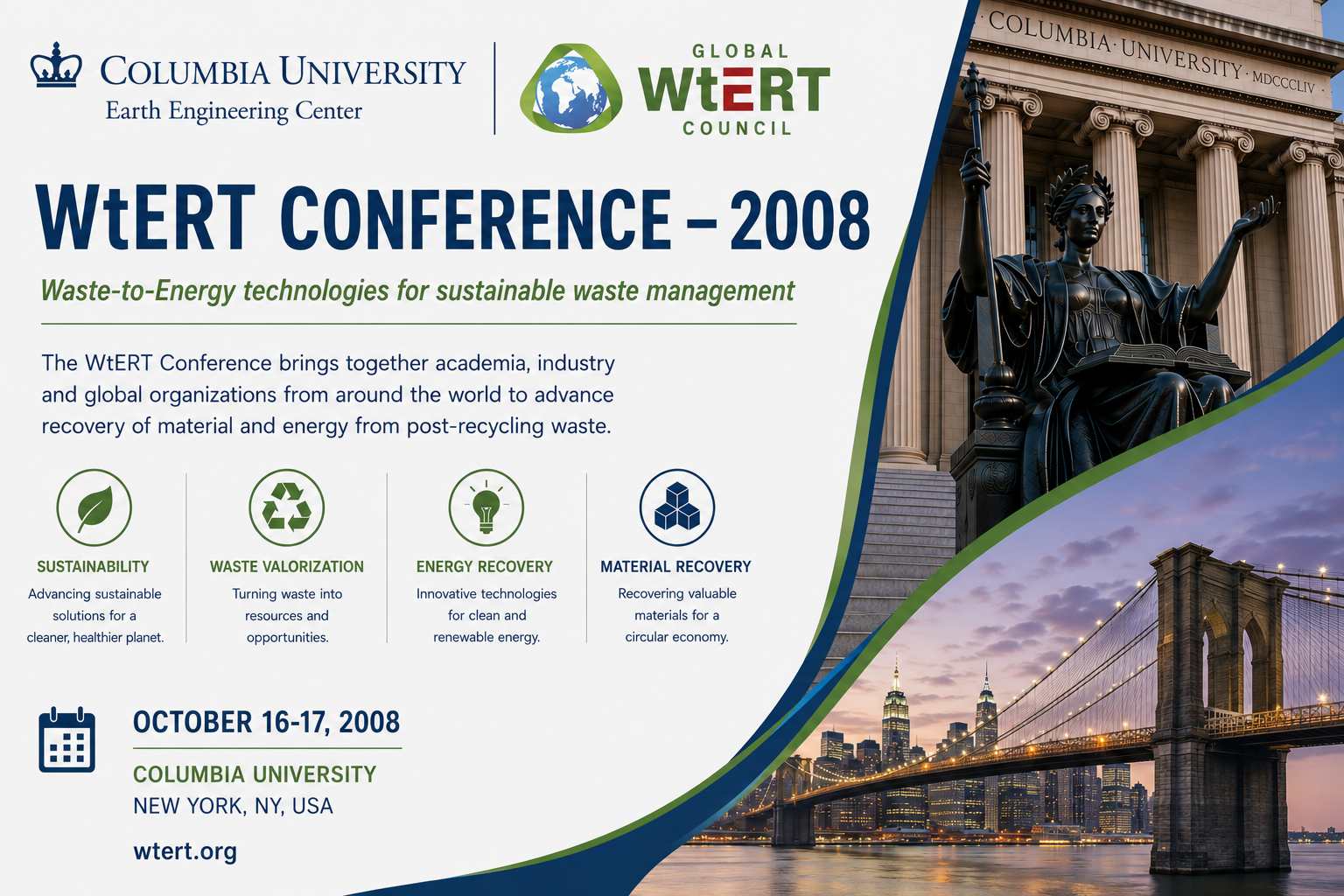
WtERT 2008 Annual Conference – Columbia University, New York
Overview On October 16-17, the Waste-to-Energy Research and Technology Council (WtERT) hosted its 2008 Bi-Annual Meeting [...]
Overview of Food Waste Composting in the U.S.
According to the State of Garbage, in 2006, forty-six of the fifty states reported tonnage data for “recycled” (composted or mulched) organics, including yard trimmings and food residuals, and/or wood (non-C&D). The total tonnage of organics composted or mulched was 20,368,139 tons in 2006 [1]. This amount represented 5% of estimated Municipal Solid Waste (MSW) generated in the U.S. (387 million tons).
Download Publication (pdf)Use of Statistical Entropy and Life Cycle Analysis to Evaluate Global Warming Potential of Waste Management Systems
The statistical entropy (SE) function has been applied to waste treatment systems to account for dilution or concentration effects on metals. We later extended it to account for carbon flows, especially in waste management systems involving thermal treatment. Now, a simple lifecycle “net energy” metric – encompassing the “lost energy” that would have been gained when high-calorific materials are landfilled rather than combusted with energy recovery – is introduced to account for additional influxes of carbon when using landfilling as the primary disposal method. When combining net energy calculations and long terms effects of landfilling, waste to energy (WTE) becomes a more attractive option for dealing with non-recycled municipal solid waste (MSW). A greenhouse gasforcing factor is also introduced to account for the entropy generating effects of methane. When incorporating forcing and lost energy, WTE performs notably better than landfills with respect to entropy generation and carbon.
Download Publication (pdf)Potential for the First WTE Facility in Mumbai (Bombay) India
The city of Mumbai (Bombay), India is facing a solid waste management crisis. The infrastructure has been unable to keep pace with economic development and population growth, resulting in insufficient collection of municipal solid waste (MSW) and over-burdened dumps. Improper disposal of solid wastes over several decades and open burning of garbage have led to serious environmental pollution and health problems. This study examined the solid waste management process in Mumbai and the potential for implementation of waste-to-energy facilities.
Download Publication (pdf)Developments In Thermal Treatment Technologies
A 2007 WTERT survey showed that the global waste-to-energy capacity (WTE) increased in the period 2001-2007 by about 4 million metric tons per annum. By far, the principal technology used globally for energy recovery from municipal solid wastes is combustion of “as received” MSW on moving grates (“mass burn” or stocker technology). This paper also includes a brief report on the results of a study by WTERT on ways to increase beneficial uses of WTE ash in the U.S.
Download Publication (pdf)Thermal Treatment Review: Global Growth of Traditional and Novel Thermal Treatment Technologies
By Nickolas J. Themelis Waste Management World, p. 37-44, July-August 2007 Global growth of traditional and novel thermal treatment technologies.
Download Publication (pdf)M.S. Thesis: Green House Gas Catalytic Reforming to Syngas
By Noah W. Whitmore
Download Thesis (pdf)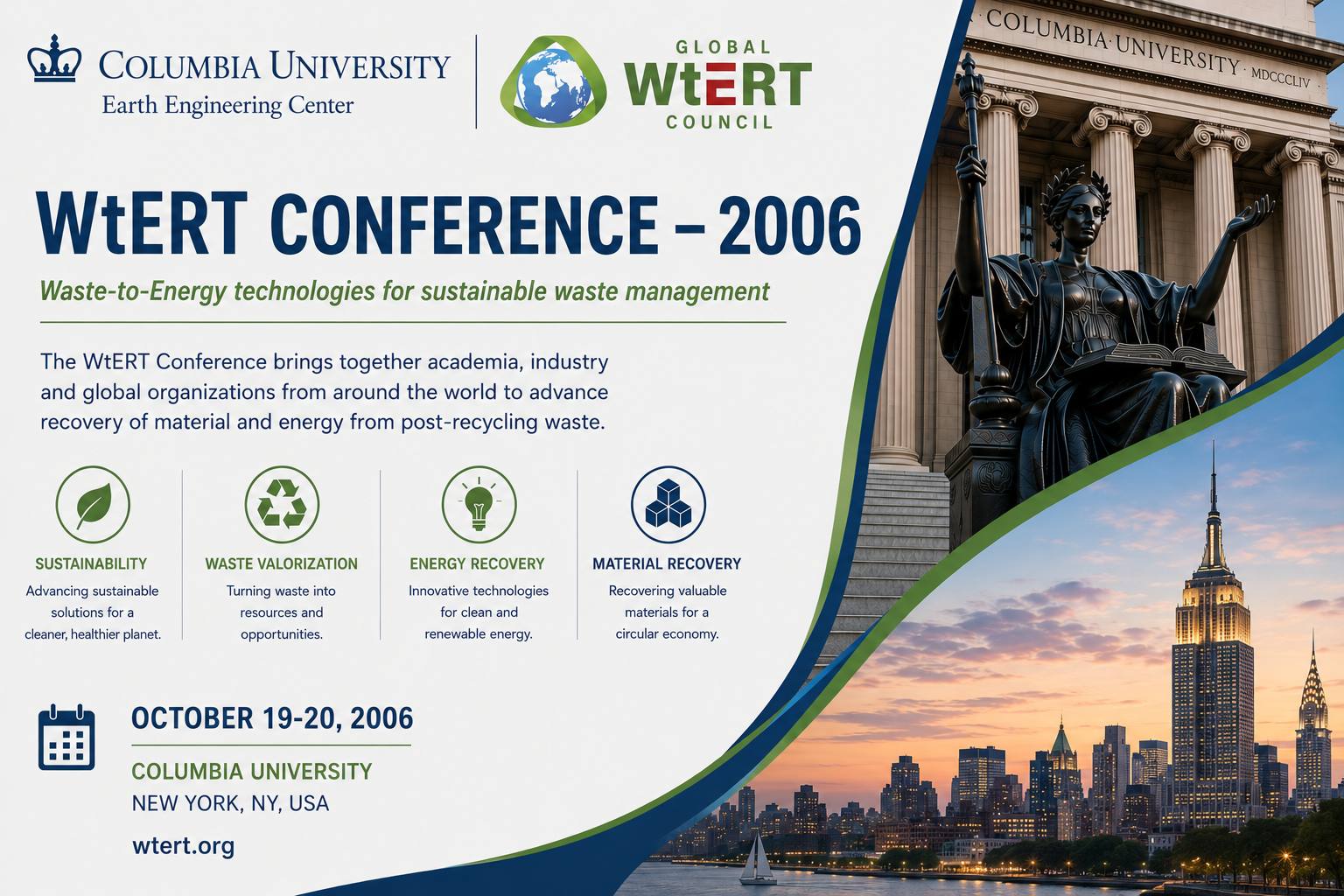
WtERT 2006 Annual Conference – Columbia University, New York
On October 16-17, 2006, the Waste-to-Energy Research and Technology Council hosted its 2006 Annual Meeting at Columbia University in the City of New York. There were 16 presentations and 12 posters in the meeting. The WtERT 2006 Education Award was presented to Prof. Paul H. Brunner of the Technical University of Vienna. The ASM Brescia (Italy) plant received the 2006 WtERT Industry Award to one of the world’s best WTE facilities.
Development of Thermal Sprayed Layers for High Temperature Areas in Waste Incineration Plants
by D. Bendix, G. Tegeder, P. Crimmann, J. Metschke, M. Faulstich WTERT-Germany October 2006
Download Publication (pdf)Municipal Solid Waste Management in Italy
Italy is a European country with population of 58.5 million. It is divided into 20 regions that can be aggregated in three macro-geographical areas (North, Center and South). The generation of municipal solid wastes (MSW) in Italy in 2004 was 31.1 million metric tones. The source - separated collection of recyclables and compostables was 22.7% of the total MSW production. However, the situation is very different between the macro-geographical areas of Italy: the North has reached a value of 35.5%, the Center 18.3% and the South 8.1%.
Download Publication (pdf)Methane Generation in Landfills
Methane gas is a by-product of landfilling municipal solid wastes (MSW). Most of the global MSW is dumped in non-regulated landfills and the generated methane is emitted to the atmosphere. Some of the modern regulated landfills attempt to capture and utilize landfill biogas, a renewable energy source, to generate electricity or heat. As of 2001, there were about one thousand landfills collecting landfill biogas worldwide.
Download Publication (pdf)M.S. Thesis: Waste-to-Energy for Santiago, Chile: A Cost-Benefit Analysis
By Paula Estevez Weinstein
Download Thesis (pdf)The State of Garbage in America
The 15th Nationwide Survey of MSW Management in the U.S.
From BioCycle Magazine - April 2006
Capture and Utilization of Landfill Gas
Renewable Energy, 2005
by Professor N.J. Themelis and Priscilla Ulloa
What is the potential for additional utilisation of landfill gas in the USA and around the world?
Investigations on Corrosion Protective Layers in Waste Incineration Plants
Peter Crimmann, Dietmar Bendix, Martin Faulstich, Sulzbach-Rosenberg / D WTERT-Germany 2005
Corrosion in the hot gas area of waste incineration plants is a severe problem that often causes premature damage of components. In general, these components are made of base materials, which are not stable in corrosive conditions (boiler steel). Thermal spraying is an alternative to the most usual process cladding, which has the potential to create cost-efficient protective coatings. Until now, there are still not enough experiences about quality assurance (porosity, oxides) and long run behaviour inside the incineration plants with sprayed coatings. Since many years, ATZ Entwicklungszentrum is involved in the development and/or advancement of materials, technologies, and applications of thermal spraying for corrosion protection. Currently, pipes, coated with different materials and different technologies are tested by different strategies (corrosion tests under laboratory scale and/or directly in incineration plants).
Download Publication (pdf)Investigation of Corrosion Protective Layers in Thermal Energy Plants
by P. Crimmann, D. Bendix, G. Tegeder, M. Faulstich WTERT-Germany 2005
Download Publication (pdf)