Hangzhou, China — May 25, 2026
By invitation of Professor Huang Qunxing, Vice Dean of the College of Energy Engineering at Zhejiang University and Executive President of WtERT, Zhejiang University hosted a one-day academic and technical exchange with distinguished faculty from Columbia University, strengthening international cooperation in sustainable waste management. The meeting was also attended by Professor Xiaodong Li, faculty member at Zhejiang University and member of WtERT.
The visit welcomed Professor Satyajit Bose and Professor Dong Guo, both Professors of Practice at Columbia University’s Research Program on Sustainability Policy & Management (SPM). This academic exchange was organized in collaboration with the Earth Engineering Center (EEC) at Columbia University and the College of Energy Engineering at Zhejiang University, with the support of Columbia Global Centers | Beijing and WtERT. The exchange aimed to foster cooperation, promote the sharing of knowledge and policies, and advance dialogue on regulatory and implementation strategies across regions.


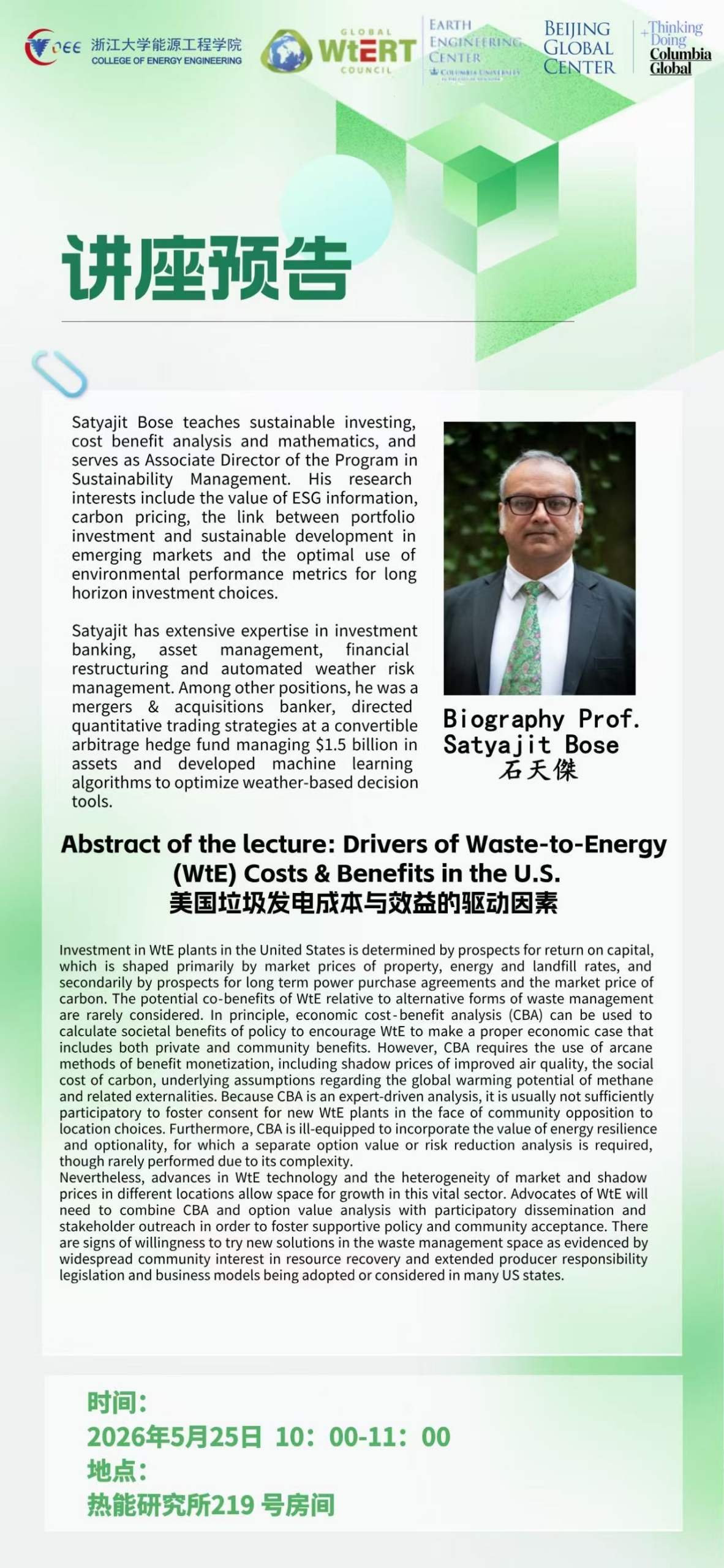
A central highlight of the program was Professor Bose’s lecture, “Drivers of Waste-to-Energy (WtE) Costs & Benefits in the U.S.”, which provided a rigorous economic perspective on the development of WtE infrastructure. He emphasized that investment decisions in the United States are primarily driven by return on capital, with land (property) prices, energy markets, and landfill costs acting as key determinants. He further highlighted the role of long-term power purchase agreements and carbon pricing as secondary drivers.
Professor Bose noted that while cost-benefit analysis (CBA) can theoretically capture the full societal value of WtE—including environmental and public health benefits—it remains complex and often insufficiently participatory to secure public acceptance. He stressed the importance of complementing CBA with option value and risk analysis, particularly to account for energy resilience, and called for stronger stakeholder engagement and policy alignment to support project deployment.
Discussions throughout the session emphasized the importance of adapting these financial and policy frameworks to diverse regional contexts, particularly in the Global South, where rapid urbanization and infrastructure constraints require scalable, cost-effective, and policy-driven solutions.
The academic exchange included laboratory visits and technical discussions with faculty and researchers, reinforcing collaboration between institutions.


In the afternoon, the delegation visited the Hangzhou Linjiang Environmental Energy Plant, one of the largest waste-to-energy facilities in Asia. The plant processes approximately 5,200 tonnes of municipal solid waste per day and generates over 1 billion kilowatt-hours of electricity annually, demonstrating the scale at which WtE can contribute to urban sustainability.
With a total investment of approximately 2.6 billion RMB (≈ 360 million USD, excluding land costs), the facility represents a major infrastructure commitment. Its environmental performance features ultra-low flue gas emissions, exceeding China’s GB18485-2014 standards and in some cases outperforming the European Union’s 2010/75/EU benchmarks.
Beyond its technical performance, the plant stands out for its architectural design. Developed with a post-industrial aesthetic inspired by flowing silk ribbons, the structure wraps elegantly around the industrial core, creating a sense of transparency and integration with the surrounding environment. This design approach transforms the facility into a landmark of modern industrial architecture, combining functionality with cultural and visual identity.
The visit also highlighted Hangzhou’s broader leadership in sustainable waste management. Recognized by the United Nations for its zero-waste strategy, the city has achieved near-complete waste valorization—approaching 98%—with minimal reliance on landfills, supported by digital systems and integrated infrastructure.
This academic exchange builds on ongoing collaboration between Zhejiang University, Columbia University, and the WtERT network, reinforcing a shared commitment to advancing sustainable waste management through research, policy innovation, and international cooperation.